Buying every padel court component from one supplier is not always necessary.
A local contractor may already have a reliable steel fabricator. A club may prefer a local electrician for lighting. A distributor may already stock artificial turf.
But there are some components that should not be separated too casually.
Why?
Because their dimensions interact.
A glass hole has to accept a fastener. A connector has to match the hole position. A glass panel has to align with the steel fixing point.
So instead of asking:
"Should I buy the whole court from one supplier?"
A more practical question is:
"Which components need to be coordinated together?"
Here are five combinations worth checking before you split a padel court order between suppliers.
1. Glass + Screw Fasteners
This is the most obvious pair, but it is still easy to separate during purchasing.
Padel court glass normally requires drilled fixing holes, and MIGO supplies glass with countersunk-hole processing for compatible mounting systems.
MIGO's current hardware range includes 5-part and 6-part screw fastener kits for 10mm and 12mm padel court glass. Depending on the configuration, these can use M8 or M10 bolts together with SS304 washers and polyamide gaskets.
The key point is not the number of pieces in the kit.
It is the relationship between:
glass thickness → countersunk hole → gasket → bolt
If you buy the glass from one supplier and the bolts from another, send both suppliers the same connection specification.
Do not simply order "M10 bolts for padel glass."
The complete fixing detail matters.
Better buying approach
If possible, confirm the glass hole drawing and fastener specification at the same time.
Even if you eventually source the hardware locally, you will know exactly what the glass has been processed to accept
2. Glass + Acrylic Connectors
Acrylic connectors look simple until you compare their dimensions.
MIGO currently documents three connector configurations.
The smaller straight model measures 160 × 50 × 10mm, while the larger version measures 213 × 80 × 10mm. A 140 × 140 × 10mm 90-degree model is also available.
These connectors do not share the same slot layout.
For example, the smaller model has a 120mm slot distance and is designed around a glass hole-center-to-edge distance of approximately 58mm. The larger model uses a 133mm slot distance and corresponds to approximately 64mm hole-center-to-edge spacing.
That means this purchasing sequence is risky:
Order glass first → choose connectors later.
A better sequence is:
Choose connection design → confirm connector → confirm glass drilling → produce glass.
The connector is inexpensive compared with the glass.
But its dimensions can determine whether the panel fits.
3. Glass + Steel Structure
This combination deserves even more attention.
The steel structure defines the physical fixing points around the court.
The glass arrives with those fixing positions already drilled.
Once tempered, the glass is not something an installer should plan to re-drill on site.
MIGO's padel range includes common 10mm and 12mm tempered glass, as well as laminated configurations such as 6mm + 1.52mm PVB + 6mm. The company also supplies steel court structures and complete court systems.
If the glass and steel come from different factories, one drawing should still control both.
Check:
Panel dimensions
Hole-center positions
Steel fixing points
Panel gaps
Court layout
Connection details
The issue is not whether two factories can make good products.
They can.
The issue is whether they are manufacturing from compatible information.
4. Steel Structure + Mesh Fencing
Glass is not the only enclosure component.
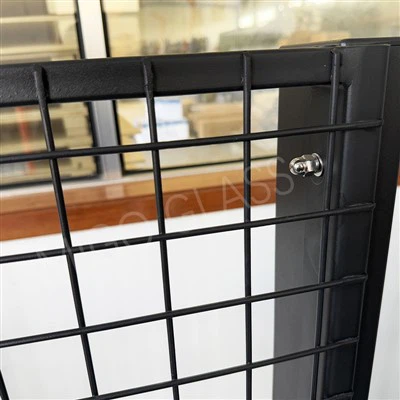
Above and beside the glass sections, mesh fencing becomes part of the court structure.
MIGO's documented court accessories include hot-dip galvanized steel welded mesh, with 45 × 45mm commonly used and 50 × 50mm available as an alternative in the current accessory specification. The documented wire thickness is 4mm for these configurations.
MIGO's current product range also shows mesh fencing designed to work alongside the steel structure and glass enclosure.
When steel and mesh are purchased separately, check more than the mesh opening.
Also confirm:
Panel dimensions
Attachment points
Frame arrangement
Required height
Finish
Court model
A mesh panel can have the correct wire and opening size but still be inconvenient to install if its overall dimensions do not correspond with the frame.
Better buying approach
Treat the mesh as a structural interface, not simply as fencing sold by the square meter.
5. Lighting Posts + Steel Structure
Lighting can be sourced separately more easily than glass hardware, but there is still one part that should be coordinated early:
the lighting-post arrangement.
MIGO's accessory specification includes hot-dip galvanized lighting posts in L, C, V, Z and customized shapes, together with LED lighting options.
The company's complete-court offering also integrates lighting with the other court components.
If the lighting poles are part of or connected to the court structure, their location should be established before the steel package is finalized.
The electrical equipment itself may still come from another supplier.
But the physical structure should know where the lighting belongs.
What About Artificial Turf?
Artificial turf is slightly different.
It is an important padel court component, but its specification does not physically determine where a glass hole should be drilled.
MIGO currently supplies PE padel turf in several configurations, including 12–15mm pile heights, different densities and multiple colors.
Turf can therefore be sourced separately more easily when:
The required specification is clearly defined
The installer understands the court dimensions
Roll sizes and quantities have been calculated correctly
The installation method is already established
That does not mean turf should be an afterthought.
It simply means its purchasing interface with the glass connection system is less direct.

Which Components Can Be Split Between Suppliers?
A complete padel court does not require a single purchasing model.
A buyer might reasonably source:
Glass + fasteners + acrylic connectors from Supplier A
Steel + mesh from Supplier B
Turf locally
Electrical installation locally
That can work.
Another buyer may prefer:
Glass + steel + mesh + turf + accessories from one supplier
That can also work.
The number of suppliers is not the real issue.
The important question is:
Who controls each interface between their products?
Use the "Interface Rule"
Before splitting an order, look at every two components and ask:
Does the dimension of Part A determine how Part B must be manufactured?
If yes, coordinate them closely.
For example:
Glass hole ↔ bolt
Yes.
Glass hole ↔ acrylic connector
Yes.
Glass hole ↔ steel fixing point
Yes.
Mesh panel ↔ steel frame
Yes.
Lighting post ↔ court structure
Often yes, depending on the design.
Turf color ↔ glass hole
No.
This simple test makes procurement decisions much clearer.
One Court, Several Suppliers, One Drawing
Using several suppliers is not automatically a problem.
Using several versions of the specification is.
If your glass supplier works from Drawing A, your steel supplier works from Drawing B and your installer receives Drawing C, even individually correct components can become difficult to assemble.
So whenever interconnected padel court parts are purchased separately, maintain one approved project reference.
That may include:
Court layout
Glass drawings
Steel drawings
Connection details
Component codes
Revision number
The paperwork is inexpensive.
Incorrectly matched hardware or glass is not.
Buy the Interface, Not Just the Product
A padel court buyer naturally compares products:
glass price, steel price, turf price, lighting price.
But successful installation depends on the spaces between those products.
The bolt has to enter the hole.
The connector has to bridge the panels.
The glass has to meet the frame.
The mesh has to attach to the structure.
So when deciding which padel court parts to source together, prioritize the components whose dimensions directly depend on each other.
MIGO supplies tempered and laminated padel court glass together with screw fastener kits, acrylic connectors, steel structures, mesh fencing, artificial turf, lighting and complete court systems. If you are splitting a project between local and overseas suppliers, you can send us the court drawing and indicate which components you already source locally. We can review the relevant interfaces for the MIGO-supplied parts.