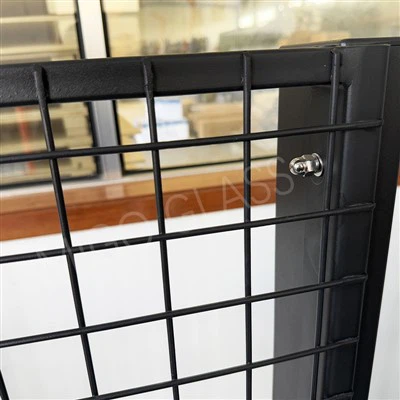
A padel court may contain large glass panels and several meters of steel structure, but the parts that cause an unexpected maintenance problem are often much smaller.
A missing bolt.
A damaged polyamide gasket.
An acrylic connector that needs replacing.
Or a glass panel that cannot be sourced quickly in the correct size and drilling pattern.
For commercial clubs, distributors and installers, spare parts are worth thinking about before the original court leaves the supplier.
The goal is not to buy a second court in pieces.
It is to identify which components would be difficult to replace quickly if something happens later.
Start With One Question: Can You Source It Locally?
Not every padel court component needs to sit in your warehouse.
Some standard items may be easy to obtain locally. Other parts are closely tied to the original court design.
A useful way to divide them is:
Generic components - potentially available from local suppliers.
Court-specific components - dimensions, holes or connection details must match the installed system.
The second group deserves more attention.
A replacement that looks similar is not necessarily compatible.
1. Keep the Fastener Specification
Fasteners are among the smallest components on the court, which makes them easy to overlook.
MIGO's documented padel glass hardware includes 5-part and 6-part screw fastener kits for 10mm and 12mm padel court glass.
Depending on the configuration, the kit can include:
M8 or M10 bolt
Cap nut
SS304 flat washer
Spring washer
Black conical polyamide gasket
Additional flat polyamide washer on the 6-part configuration
The documented systems are designed around compatible countersunk glass holes such as 18/30mm or 20/30mm.
That means the useful spare is not simply:
"some stainless steel bolts."
Record the complete hardware specification used on the installed court.
If replacement becomes necessary later, you want to know exactly which system was originally supplied.
2. Don't Forget the Polyamide Gaskets
A gasket costs very little compared with a large tempered glass panel.
Its size does not make it unimportant.
In MIGO's glass fixing systems, polyamide components sit within the fastener assembly rather than leaving the metal hardware as a simple bolt-through-glass connection.
For operators, these are sensible components to identify when preparing a spare-parts box.
More importantly, keep them separated and labeled according to the fastener system.
Mixing similar-looking hardware from different court models can create unnecessary confusion during maintenance.

3. Match Spare Acrylic Connectors to the Installed Model
"Acrylic connector" is not one universal part.
MIGO's documented range includes several configurations.
Model 1
160 × 50 × 10mm
Weight: 87g
Slot options include 20 × 8.5mm for M8 and 20 × 10.5mm for M10.
Model 2
213 × 80 × 10mm
Weight: 176g
Slot size: 18 × 12mm for M10
90-Degree Connector
140 × 140 × 10mm
Designed for 10–12mm glass, with slots available for M8 or M10 configurations.
If your court uses acrylic connectors, record the model rather than relying on a photograph later.
For multi-court facilities, this becomes even more useful if different court models use different connectors.
4. Should You Keep Spare Glass?
This depends on the project.
Padel court glass is very different from keeping a box of spare bolts.
Panels are large, heavy and need suitable storage.
But replacement lead time can also be much longer because a panel may require:
Correct dimensions
Correct thickness
Correct hole quantity
Correct hole position
Correct countersunk-hole configuration
Appropriate edge processing
MIGO's documented padel glass range includes 10mm and 12mm tempered glass and 6mm + 1.52mm PVB + 6mm laminated glass.
For a commercial facility with several identical courts, keeping selected replacement panels may be worth evaluating.
For a single private court, storing large spare panels may be less practical.
There is no universal quantity that every project should order.
The important part is to make the decision deliberately rather than discovering the replacement issue only after damage occurs.
5. If You Don't Store Glass, Store the Drawing
This may be the most useful spare part that takes up no warehouse space.
Keep the final approved glass drawing.
Not an early quotation drawing.
Not a photograph.
The final production drawing.
It should allow the original panel to be identified by its dimensions and processing details.
This matters because MIGO's padel court documentation shows different glass layouts and drilling arrangements depending on the court configuration.
Months or years after installation, the person requesting replacement glass may not be the same person who purchased the original court.
Good records make that conversation much easier.
6. Keep Component Codes With the Court
For commercial clubs or distributors, create a simple record for each court model.
It can include:
Court model
Glass specification
Glass drawing number
Fastener kit
Acrylic connector model
Steel finish
Mesh specification
Turf specification
Lighting specification
This does not need to become a complicated database.
A clear PDF, spreadsheet or maintenance folder can be enough.
The purpose is traceability.
If someone asks for a replacement component two years later, you should not need to dismantle another court just to work out what was originally installed.
7. Think Differently About Turf, Mesh and Steel
Not every component belongs in a traditional spare-parts box.
Artificial turf, welded mesh panels and structural steel components take more space and may depend heavily on the actual repair.
MIGO's current complete-court specifications include PE artificial turf, hot-dip galvanized welded mesh and galvanized steel structural components.
For these products, retaining the original specification may be more practical than physically stocking complete replacement sections.
If replacement is required later, you have a reference for sourcing the correct material.
What Should Be in a Basic Spare-Parts Plan?
Instead of using one fixed list for every project, divide the plan into three levels.
Keep On Site
Small, court-specific components that are easy to store and useful to identify quickly.
Examples may include the correct fastener components and compatible connector parts used by the particular court.
Keep in Records
Specifications and drawings for components that are too large to store conveniently.
This includes glass drawings, steel information, mesh specification and turf details.
Evaluate by Project
Large replacement items such as complete glass panels.
Whether these should be stocked depends on the number of courts, storage space, court configuration and acceptable replacement lead time.
Spare Parts Should Be Planned Before Shipping
The easiest time to identify a court component is when the order is still being produced.
The drawings are available.
The hardware specification is known.
The connector models are being packed.
The buyer and supplier are already discussing the same court.
After installation, those details can gradually become harder to trace-especially if the facility changes staff or the distributor handles many different court models.
So before the container closes, ask:
If one component needs replacing later, will we know exactly what to order?
If the answer is yes, the spare-parts plan is probably doing its job.
MIGO supplies padel court glass together with compatible fastener kits, acrylic connectors, artificial turf, mesh fencing, steel structures, lighting and complete court systems. If you are preparing a commercial or multi-court project, you can send us your court configuration and we can help identify which component specifications should be retained for future replacement.