

As the international padel industry continues to develop, court builders and glass suppliers are paying greater attention to the manufacturing quality of tempered glass panels. Beyond thickness and impact resistance, glass flatness and optical distortion are becoming important considerations when selecting materials for professional padel court construction.
One technical factor receiving attention is roller wave, a type of surface distortion that can occur during the horizontal glass tempering process.
Understanding Roller Wave in Tempered Glass
Roller wave refers to a repetitive wave-like deformation that may develop when heated glass travels through a tempering furnace on ceramic rollers.
During the heating process, glass becomes softer and may slightly sag between supporting rollers. This can create small variations in surface flatness.
Although roller wave is a characteristic associated with horizontal heat treatment, excessive distortion can affect the visual appearance of glass, particularly when reflected images are observed across large panels.
For padel courts, where transparent glass walls are an important part of the overall design, maintaining good optical quality is an important manufacturing consideration.
Why Glass Flatness Matters for Padel Courts
Professional padel courts use large tempered glass panels to create playing enclosures and provide clear visibility for spectators.
When glass panels have noticeable surface distortion, reflected images may appear uneven or wavy. This can affect the overall appearance of panoramic courts and premium sports facilities.
For court manufacturers and contractors, important quality considerations include:
- Glass surface flatness
- Roller wave distortion control
- Consistent panel dimensions
- Edge processing quality
- Tempering consistency
- Accurate installation compatibility
These factors are particularly relevant for projects involving multiple glass panels, where consistent visual quality is important.

Manufacturing Process Influences Roller Wave Performance
Controlling roller wave requires careful management of the glass tempering process.
Factors such as heating temperature, heating time, roller condition, glass thickness, and cooling conditions can influence the final glass shape.
Professional manufacturers therefore need to monitor production parameters and maintain suitable equipment conditions to improve consistency.
It is also important to recognize that completely eliminating roller wave from horizontally tempered glass is not realistic. The objective is to control distortion within agreed technical requirements.
Quality Inspection Supports Reliable Court Installation
For international padel court projects, glass quality should be evaluated through more than visual inspection alone.
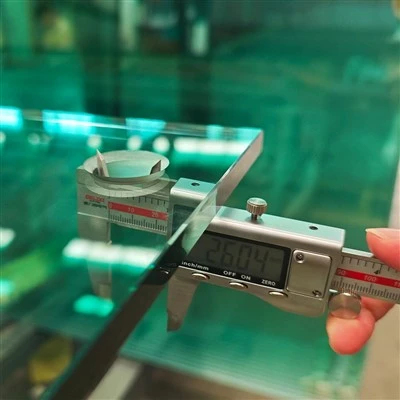
Manufacturers and buyers should consider dimensional measurements, flatness checks, surface appearance, and tempering quality before shipment.
MIGO Glass supplies 10mm and 12mm tempered glass for padel court applications, with customized dimensions, drilled holes, and polished edges according to project requirements.
The company also incorporates glass flatness inspection and processing checks into its quality control procedures to support consistent product quality.
Better Glass Quality Supports Professional Padel Facilities
As padel court construction becomes more professional, buyers are increasingly evaluating suppliers based on manufacturing consistency rather than glass thickness alone.
Roller wave control, surface flatness, and optical quality are important considerations when selecting tempered glass for modern sports facilities.
For international contractors and court brands, working with a manufacturer that understands these technical requirements can help improve product consistency and support more reliable court installations.
MIGO Glass continues to focus on tempered safety glass manufacturing and customized solutions for global padel court projects.


