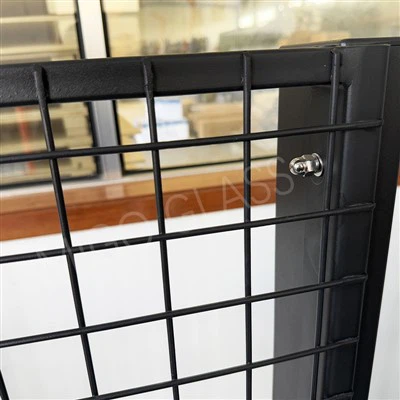
In the booming development of padel sports, the glass wall – as a core component of the court – directly affects the safety of athletes, the viewing experience of spectators and the long-term operation of the venue. Among the many technical parameters of padel court glass walls, thickness is a key indicator that cannot be ignored. Currently, the mainstream thickness specifications of padel court glass walls are 10mm tempered glass, 12mm tempered glass and 6mm + 1.52PVB + 6mm laminated glass. Each specification has unique characteristics and advantages, and is suitable for different types of padel courts.
10mm Tempered Padel Court Glass Walls
10mm tempered glass is the "standard configuration" for most conventional padel courts. In terms of characteristics, it is made by heating ordinary float glass to near the softening point (about 600 - 650℃) and then performing rapid uniform cooling. This process forms a uniform compressive stress layer on the glass surface and a tensile stress layer inside, making its mechanical properties significantly improved. Its impact resistance is 3 - 5 times that of ordinary glass of the same thickness, which can easily withstand the impact of padel balls (the speed of padel balls can reach 120 - 150 km/h during competitions) without cracking.

In terms of advantages, 10mm tempered glass has a moderate thickness, which not only meets the safety needs of daily competitions and training but also has excellent light transmittance (up to 90% or more). It can maximize the introduction of natural light into the court, allowing athletes to clearly judge the trajectory of the ball and ensuring that spectators have an unobstructed viewing experience.
In terms of cost, it is more economical than 12mm tempered glass and laminated glass, so it is widely used in community padel courts, school training courts, and commercial venues with general traffic volume.
12mm Tempered Padel Court Glass Walls
12mm tempered glass is a "strengthened option" for high-demand padel courts. Compared with 10mm tempered glass, its thicker base material further enhances its load-bearing capacity and impact resistance. The bending strength of 12mm tempered glass is about 10% - 15% higher than that of 10mm tempered glass, and it can withstand more frequent and intense impacts.

For example, in professional padel competitions, where athletes hit the ball harder and the frequency of ball impacts on the glass wall is higher, 12mm tempered glass can maintain stable performance for a longer time and is not easy to produce micro-cracks. In addition, 12mm tempered glass has better wind pressure resistance and thermal stability.
For outdoor panoramic padel courts (courts with three or four sides made of glass walls), which are often exposed to harsh weather conditions such as strong winds and extreme temperature differences, 12mm tempered glass can avoid deformation or breakage caused by environmental factors. Therefore, it is often used in professional competition venues, high-end commercial sports clubs and outdoor panoramic padel courts.
13.52mm Laminated Padel Court Glass Walls
6mm + 1.52PVB + 6mm laminated glass is a "safety-oriented choice" for padel courts with high safety requirements. It is composed of two layers of 6mm tempered glass and a 1.52mm thick PVB (polyvinyl butyral) interlayer. The biggest characteristic of this glass is that even if the glass is broken by extreme external forces, the PVB interlayer can firmly bond the broken glass fragments together, preventing the fragments from splashing and causing injury to athletes or spectators.

In terms of performance, the PVB interlayer also has a certain sound insulation effect, which can reduce the noise generated by the ball hitting the glass wall and improve the comfort of the court environment. In addition, the laminated glass has good UV resistance, and the PVB interlayer can block most of the ultraviolet rays, preventing the fading of the court floor and surrounding facilities caused by long-term sunlight exposure.
However, compared with single-layer tempered glass, the light transmittance of laminated glass is slightly lower (about 85% - 88%), and the cost is higher. It is usually used in children's padel training courts, indoor padel courts with high safety standards, and venues located in areas with frequent extreme weather (such as areas prone to hail).
In conclusion, the choice of padel court glass wall thickness needs to comprehensively consider factors such as the use scenario of the court, the intensity of use, safety requirements, and budget. Whether it is the economical 10mm tempered glass, the high-strength 12mm tempered glass, or the safe laminated glass, each specification plays an irreplaceable role in different application scenarios, providing a solid guarantee for the safe and smooth development of padel sports.
MIGO GLASS provides premium padel court glass that meets international standards, exported to North America, Europe, the Middle East & South America. Contact us for more solutions for your padel court construction.