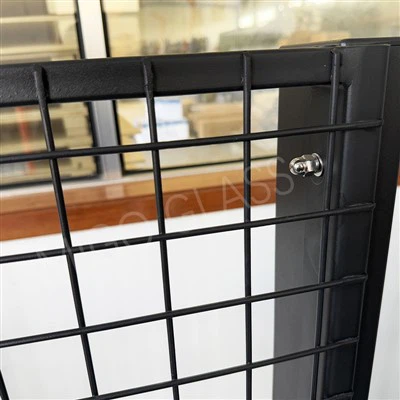
15mm tempered glass is increasingly used in premium padel court projects where higher rigidity, reduced vibration, and a stronger visual presence are required. However, thickness alone does not guarantee safety. The final performance of the court depends on the quality of the glass, the supporting steel structure, the fixing system, and the installation method.
For commercial projects, buyers should evaluate 15mm glass as part of a complete engineered system rather than as an individual panel.
Fully Tempered Safety Glass Is Essential
Padel court panels should be manufactured from fully tempered safety glass, not ordinary float glass or partially heat-treated glass.
The tempering process increases the strength of the panel and gives it safer breakage characteristics. If failure occurs, properly tempered glass should fragment into relatively small pieces rather than large, sharp sections.
Depending on the destination market and project specification, buyers may request compliance with recognized standards such as:
- EN 12150
- ANSI Z97.1
- CPSC 16 CFR 1201
- SGCC certification
Applicable local building regulations
The exact requirement should be confirmed with the local contractor or project engineer before production.
Structural Design Must Match the Additional Weight
A 15mm glass panel is significantly heavier than a 10mm or 12mm panel of the same size. This additional load affects the full court structure.
Engineers may need to review:
- Steel post dimensions
- Base plate thickness
- Anchor bolt capacity
- Foundation strength
- Glass connector load capacity
- Wind-load performance
It is not good practice to replace thinner panels with 15mm glass while keeping the original supporting system unchanged.
The steel structure and connection details should be checked as one integrated design.
Edge and Hole Processing Require Tight Control
Tempered glass is highly sensitive around its edges, corners, and fixing holes. Poor processing can create weak points that increase the risk of damage during transport or installation.
Professional-quality panels should have:
- CNC-polished edges
- Smooth corner finishing
- Accurate hole diameters
- Consistent hole locations
- No visible edge chips or micro-cracks
All cutting, drilling, and edge processing must be completed before tempering because tempered glass cannot be modified safely afterward.
Fixing Points Must Avoid Stress Concentration
Metal connectors should never press directly against the glass.
A reliable installation system normally includes:
- UV-resistant EPDM gaskets
- Protective sleeves around bolts
- Controlled tightening pressure
- Suitable expansion gaps
- Accurate frame alignment
Over-tightened connectors or uneven steel posts can create localized stress around drilled holes. These problems may not cause immediate breakage, but they can reduce long-term reliability.
Quality Inspection Checklist
| Inspection Area | Buyer Requirement |
|---|---|
| Thickness | Confirm actual 15mm specification and tolerance |
| Dimensions | Match approved production drawings |
| Hole Position | Compatible with the connector system |
| Edge Finish | Smooth and free from visible chips |
| Flatness | Supports accurate panel alignment |
| Tempering | Verified safety performance |
| Certification | Suitable for the destination market |
| Packaging | Reinforced for heavy export panels |
For bulk projects, buyers may also request batch inspection records, fragmentation tests, dimensional reports, and pre-shipment photos.
Final Consideration
The main advantage of 15mm padel court glass is not simply greater thickness. Its value comes from combining high-quality tempering, precise processing, reinforced structural support, suitable connectors, and professional installation.
For premium commercial courts, all these elements should be reviewed before an order is approved. A well-engineered 15mm glass system can provide excellent stability and long-term performance, while an incorrectly matched system may create unnecessary installation and safety risks.