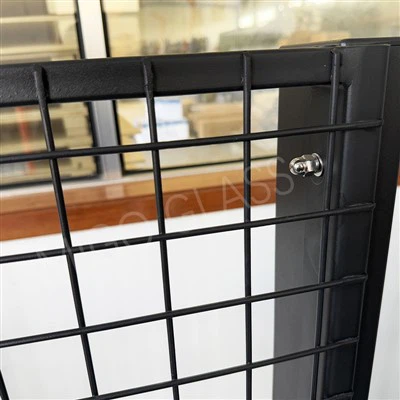
Although glass corner connectors are relatively small, inconspicuous metal components on a padel court, they are essential to the overall structural strength, seamless panel alignment, and long-term service stability of any padel facility. In full panoramic padel court designs-where large continuous glass panels form the main enclosure without dense vertical supports-the corner connector system directly governs how securely adjacent glass panels lock together, bears lateral impact from ball hits, and withstands long-term wind load and temperature expansion deformation. Even minor flaws in these tiny fittings will amplify structural risks across the entire glass fence system over years of use.
When selecting corner connectors, experienced padel court contractors, wholesalers and venue investors prioritize engineering performance and long-term durability, rather than superficial appearance or upfront low unit price. Cheap, poorly engineered connectors often lead to hidden maintenance costs, delayed construction and customer complaints in the post-installation phase.
Material Selection
Professional heavy-duty padel court glass corner connectors are commonly manufactured from three mainstream metal substrates:
- 304 stainless steel
- 316 stainless steel
- Hot-dip galvanized carbon steel
Each material fits distinct application scenarios. Hot-dip galvanized steel is a cost-effective pick for inland dry regions with low air salinity, delivering basic anti-rust performance at a lower material cost. 304 stainless steel strikes a balanced performance-to-price ratio, suited for inland urban venues with normal humidity and no salt erosion. For coastal, seaside or high-humidity subtropical environments, 316 stainless steel is universally recommended by structural engineers, as its molybdenum alloy composition delivers superior resistance to salt fog corrosion, acid rain staining and chloride ion erosion, drastically extending the service life of glass fences exposed to harsh outdoor weather.
Key Factors to Evaluate
Before placing bulk orders for glass corner connectors, professional buyers and installers must systematically inspect seven core technical indicators to avoid construction defects:
- Material grade certification
- Connector plate thickness and cross-sectional rigidity
- CNC precision machining tolerance
- Full penetration welding quality
- Uniform anti-rust surface finish
- Static and dynamic load-bearing capacity
- Matching dimensional tolerance for glass and frames
Precision CNC machining is particularly critical among all indicators. If connector dimensional tolerances deviate even slightly from standard specifications, field installers will face major difficulties leveling and aligning glass panels. Misaligned fittings force installers to pry glass into position, creating persistent internal stress on glass edges. This hidden stress gradually raises the risk of spontaneous glass cracking under temperature changes or regular ball impact months after completion.
A well-documented real case illustrates this risk: one padel court contractor in southern Spain sourced low-cost, low-precision cast corner connectors for a 12-court panoramic venue project. After glass installation, uneven, inconsistent gaps appeared between nearly every adjacent glass panel. While the irregular gaps did not immediately compromise structural safety, crews spent an extra 8 working days reworking and adjusting all glass panels, adding thousands of euros in overtime labor fees and pushing the project handover date back by over a week. The venue owner also raised aesthetic complaints about the uneven glass seams, damaging the contractor's local industry reputation.
Compatibility With the Complete Court System
Glass corner connectors are not universal hardware; they must be fully matched to the full set of padel court system parameters to guarantee stable installation:
- Glass panel thickness: standard 10mm, medium 12mm, heavy-duty impact-resistant 15mm tempered glass
- Pre-drilled hole diameter and center-to-center hole spacing on glass
- Cross-section and wall thickness of the main steel support frame
- Venue type: panoramic full-glass court or traditional standard court with dense metal posts
Deploying mismatched, ill-fitting connectors creates cascading problems: offset mounting holes require forced drilling or grinding on-site, loose clamping pressure causes glass wobble during use, and uneven force distribution accelerates metal rust and glass edge wear, severely undermining long-term structural stability of the entire court enclosure.
Professional Supplier Pre-Order Inspection Checklist
Qualified manufacturers must provide full supporting test documents and finished product inspections before delivery; buyers should verify all items below:
| Inspection Item | Core Significance |
|---|---|
| Material Grade Certification | Official material test report confirming stainless steel or galvanized steel alloy composition, avoiding counterfeit low-grade metal |
| CNC Machining Accuracy Report | Strict dimensional tolerance control eliminates on-site adjustment work, speeds up glass installation and reduces labor waste |
| Complete Surface Treatment Records | Uniform polishing, passivation or galvanization layers block air and moisture contact, greatly boosting anti-corrosion lifespan outdoors |
| Independent Load Test Report | Static pressure and dynamic impact load testing verifies the connector can withstand padel ball strikes, wind pressure and human collision without deformation or fracture |
| Batch Full Quality Inspection Records | Consistent production standards across all batches, preventing mixed defective fittings in bulk shipments |
As panoramic full-glass padel courts continue to surge in global popularity for their unobstructed viewing experience and modern aesthetic, venue contractors and investors are gradually shifting away from cost-only purchasing logic. High-precision, corrosion-resistant corner connector systems have become a non-negotiable core component, streamlining on-site installation efficiency while significantly lifting the long-term structural integrity, safety and aesthetic consistency of finished padel courts.