


Choosing the type of lamp suitable for padel courts requires comprehensive consideration of lighting performance, usage scenarios, cost-effectiveness, maintenance convenience and other factors, while also meeting the International Cricket Council (ICC) event standards and actual venue requirements. The following are specific selection points and analysis of common lamp types:
1. Illuminance and uniformity
The lamps must be able to provide sufficient illumination (≥1500lx for international matches, 500-1000lx for training grounds) and have uniform light distribution (the deviation between the illumination at any point and the average value is <20%). The coverage range needs to be calculated based on the size of the venue, the power of the lamps and the beam angle to avoid dark or overly bright areas.
The beam angle needs to be adapted to the venue area: the core area (pitching area, wicket) is suitable for narrow beams (15°-30°) to concentrate the illumination, and the outfield is suitable for wide beams (60°-90°) to expand the coverage.
Glare control
In cricket, players need to look up frequently to see the ball, and glare will seriously affect judgment, so the unified glare value (UGR) of the lamps needs to be ≤22 (high-quality systems can be controlled below 19). Lamps with deep anti-glare covers and shading angles ≥30° are preferred to reduce the interference of direct light on vision.
Color rendering index (CRI)
Needs to be ≥90 to ensure accurate restoration of the white color of the ball, the color of the players' clothing and the details of the field, to help players judge the rotation and trajectory of the ball, and to meet the requirements of TV broadcasts for color authenticity.
Color temperature adaptation
4000K-6500K is the common range: 4000K warm white light is suitable for training and small games, with high visual comfort; 5000K-6500K cold white light is suitable for large-scale events and TV broadcasts, which can improve picture clarity.
Energy consumption and life
The lamps must have high luminous efficiency (≥100lm/W) to reduce long-term operating costs; the life must be long enough (≥50,000 hours) to reduce the frequency of replacement, especially for venues with high lamp posts (difficult to maintain).
Startup and dimming performance
Support instant startup (no warm-up time) to avoid interruptions to the game; with dimming function (0-100% adjustable), it can adapt to the lighting needs of different scenes such as training, warm-up, and broadcasting.
Environmental adaptability
It must have good waterproof (IP65 and above), dustproof, and windproof performance, and be able to cope with outdoor rainy, strong wind and other severe weather to ensure long-term stable operation.
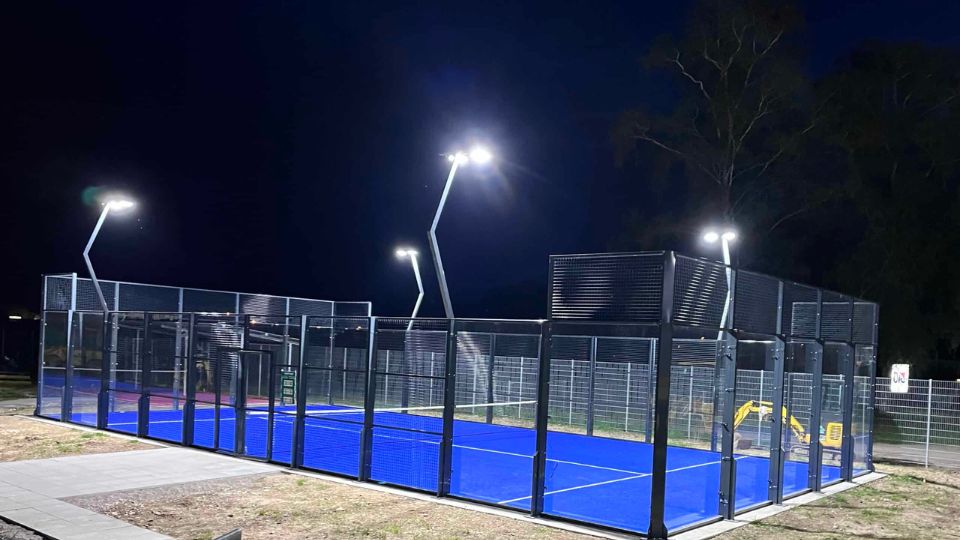
One standard padel court has 4 lighting points.
They are placed either on the sides of the court at approximately 4m from corners, on vertical (two for each side), Or starting directly from the corners of the courts, on diagonal.
Each lighting point goes up to 6m in height
It is recommended to install a minimum of 8 LED lights of 200W each, or 4 LED lights of 400W each.

Specification of the above LED light
Light color: 5000K ;
Input voltage: AC 110~277V
Light source: Philips chip;
Light driver: Philips power supply
Lighting angle: horizontal polarization;
Shell: galvanized sheet spraying
If you are interested in our padel court LED light, drop us a line through the contact form below.
Or contact the salesperson directly:
Contact: Bella Xie
E-mail: bella@migoglass.com
Phone: +8618561397391(WhatsApp)
Hot Tags: padel court standard led lighting, China padel court standard led lighting manufacturers, suppliers, factory, tightening fence wire, outdoor artificial grass, heavy duty barrier fencing, double wire mesh, artificial turf for backyard, removable mesh pool fence


