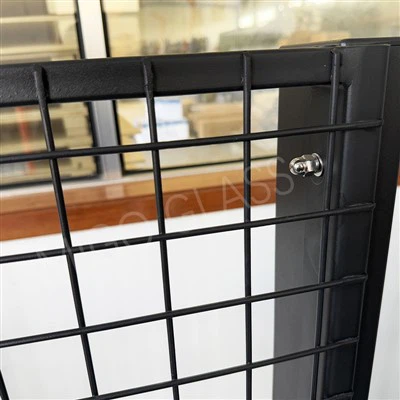
In the construction of modern sports venues and multi-functional sports fields, glass materials have gradually become key design elements due to their light transmittance, strength and safety. With the advancement of materials science, strict standards have been formed for the production and acceptance of multi-functional sports field glass to ensure that the functional requirements of different scenarios are met.
According to internationally accepted quality specifications, multi-functional sports field glass must meet a series of key indicators. In terms of material performance, glass must have high-strength impact resistance, usually through a drop ball impact test, and remain intact when simulating human or natural external force impact. The surface hardness is required to reach Mohs hardness level 6 or above to resist wear, scratches and chemical corrosion and extend service life. For transparent or translucent glass, the light transmittance must be stable in the range of 85% to 92%, which not only ensures sufficient natural light intake, but also needs to be matched with anti-glare coating to reduce visual fatigue.
Safety performance is an important indicator. Glass must be processed by tempering or lamination to ensure that blunt-angle granular fragments are formed after breaking to reduce the risk of personal injury. Glass used in high humidity areas such as ice rinks and swimming pools must have anti-condensation function, and the double-layer hollow or Low-E coating technology is used to improve the thermal insulation performance and reduce the condensation of water vapor caused by temperature difference. For the soundproof glass of sports venues, the sound insulation level must reach STC-35 decibels or above to effectively block the interference of environmental noise.
Installation specifications should not be ignored either. The edges of the glass need to be chamfered to avoid stress concentration and self-explosion, and elastic sealing strips are used to achieve seamless fixation. The testing process covers weather resistance testing, load-bearing simulation and dynamic wind pressure load experiments to ensure that the product can adapt to extreme climate conditions and high-frequency usage scenarios.
With the popularization of green sports building standards, multi-functional sports field glass in the future will pay more attention to environmental protection attributes, such as increasing the utilization rate of recycled materials and improving low-carbon production processes, to promote the industry to move towards sustainability.