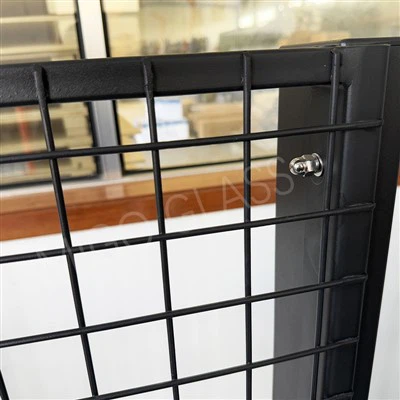
Squash court wall glass must simultaneously meet two core requirements: "resistance to high-frequency, high-speed impacts" and "ensure player safety." The performance differences between tempered glass and laminated glass directly impact the venue's user experience and safety level. The following in-depth comparison, focusing on performance compatibility, scenario matching, and decision-making logic, will assist practitioners in making accurate product selections.
1. Core Performance Comparison
In squash, ball speeds often exceed 150 km/h, and players frequently hit the wall to save. This puts glass's impact resistance and safety protection capabilities to rigorous testing, resulting in significant performance differences between the two types of glass:
1.1 Impact Resistance and Structural Stability
Tempered glass: Its core advantage is "rigidity and impact resistance." Through a high-temperature quenching process, uniform compressive stress is applied to the glass surface, resulting in an impact strength 3-5 times that of ordinary glass. 8mm thick tempered glass can easily withstand a direct impact from a 150 km/h squash ball and even withstand minor knocks from the edge of a racket, making it suitable for less frequent daily play. However, it suffers from the disadvantage of brittle fracture: if subjected to extreme impact (such as a player throwing a racket in a fit of rage, or being struck by falling objects), the glass will instantly shatter into blunt-angled particles the size of soybeans (which meet national safety glass standards). While these will not scratch the human body, they will completely lose their protective capabilities.
Laminated glass: Its core design is based on "energy absorption and structural preservation." The mainstream specification is "tempered glass + PVB laminated glass + tempered glass." The PVB laminated layer acts as an elastic cushion, absorbing over 60% of the impact energy. When a squash ball hits at 150 km/h, the outer tempered glass may crack, but the laminated layer will firmly hold the fragments, preventing them from flying and preventing the glass from losing its integrity.

1.2 Safety Protection Level
Tempered glass: Its safety relies on passive protection based on "breakage pattern." While blunt-angled particles pose no scratching risk, the gaps created by the shattered glass can pose secondary risks: first, a squash ball could pass through the gap and hit spectators or equipment outside the court; second, players could get their hands or feet caught in the gap between the glass and the frame when trying to save the ball, causing sprains.
Laminated glass: Safety relies on the active protection of "structural integrity." Even if the outer glass shatters, the interlayer secures the fragments in place, maintaining the integrity of the wall. There are no flying fragments that could scratch players, and no gaps that could cause balls to pass through or people to become trapped.
2. Matching Scenario Requirements
The glass type should be precisely matched to the squash court's "intensity of use, target audience, and operational objectives" to avoid blind selection:
2.1 Professional Competition/High-Frequency Training Venues
For venues like these, where the average daily high-intensity ball hitting exceeds 300 times and must meet the safety standards of the World Squash Federation (WSF), laminated glass is preferred. There are three core reasons for this: First, tournaments demand high continuity, and laminated glass's "break-and-remain" property prevents interruptions due to glass shattering. Second, professional players strike the ball with high power, and the interlayer's energy-absorbing cushioning decreases fatigue damage produced by prolonged stress. Third, spectator seating is common in tournament settings, and the shatter-proof and field-penetration-resistant qualities of laminated glass entirely remove the chance of spectator harm, ensuring that international tournament safety criteria are met.
2.2 Youth/Children's Training Venues
Safety must be prioritized for these venues, making laminated glass a mandatory choice. Children and adolescents often have unregulated ball-saving techniques, easily colliding with the wall. A thicker interlayer can further enhance the cushioning effect, reducing bruises and abrasions caused by impact. Furthermore, children have a weaker ability to anticipate danger, and laminated glass's "no shatters, no gaps" properties completely eliminate safety hazards.
In conclusion, tempered glass is appropriate for leisure venues with low frequency, low cost, and an adult audience, whereas laminated glass is appropriate for competition and training venues with high frequency, high security, and a professional/child audience. The key to picking the proper glass is to match its performance to the venue's actual demands, rather of focusing solely on high cost or hardness.