As padel continues to grow worldwide, more clubs, sports investors, and contractors are looking to build courts that meet international standards. Whether you are planning a commercial sports club, a private facility, or a competition venue, understanding the FIP requirements for padel tennis court construction is essential.
The International Padel Federation (FIP) establishes the official rules and technical requirements that ensure every court provides a safe, fair, and consistent playing experience. In this guide, we'll explain the most important FIP requirements and how to select the right materials for a professional padel court.
What Is FIP?
The International Padel Federation (FIP) is the governing body responsible for regulating the sport of padel worldwide. Its official regulations cover not only the rules of play but also the technical specifications for court construction, including dimensions, safety, lighting, fencing, glass panels, and playing surfaces.
Building a court according to FIP standards ensures:
Professional playing performance
Player safety
Consistent ball rebound
Compatibility with international competitions
Higher commercial value for clubs and investors
1. Official Padel Court Dimensions
A standard FIP padel court must have the following internal dimensions:
| Specification | FIP Requirement |
|---|---|
| Court Length | 20 m |
| Court Width | 10 m |
| Minimum Free Height | 6 m |
| Recommended Height (New Facilities) | 8 m |
| Line Width | 50 mm |
| Net Height (Center) | 0.88 m |
| Net Height (Posts) | 0.92 m |
The court is divided equally by a net, with service lines positioned 6.95 meters from the net on both sides.
2. Court Enclosure Requirements
Unlike tennis courts, a padel court is completely enclosed, allowing players to use the walls as part of the game.
The enclosure consists of:
3-meter tempered glass walls
4-meter total enclosure height
Square welded mesh fencing above the glass
FIP recognizes two common enclosure designs:
Classic Padel Court
The traditional design combines stepped side walls with welded mesh fencing. It is widely used for recreational and club installations.
Panoramic Padel Court
The panoramic design replaces corner steel posts with large tempered glass panels, creating unobstructed visibility for spectators and live broadcasting. Today, panoramic courts have become the preferred choice for premium clubs and professional tournaments.
3. Tempered Glass Requirements
Glass is one of the most important structural components of a padel court.
According to FIP requirements, the glass should provide:
Excellent impact resistance
Uniform ball rebound
Smooth and flat surface
Safe performance during play
Although the FIP Rules do not specify glass thickness, 12 mm tempered safety glass has become the international industry standard for outdoor padel courts because it offers an excellent balance of strength, durability, and optical clarity.
For premium facilities, additional options include:
Ultra-clear tempered glass
Laminated acoustic glass
Bird-friendly printed glass
Ceramic frit glass
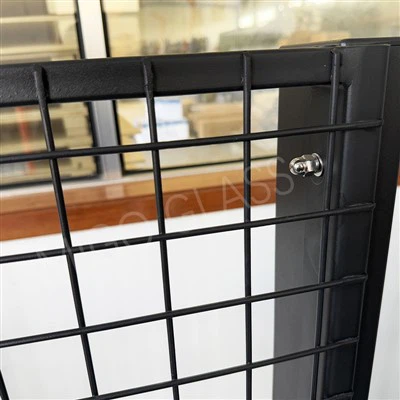
4. Mesh Fence Requirements
The mesh fence influences both safety and ball rebound.
FIP specifies:
Square electro-welded mesh
Mesh opening (diagonal): 50–70.8 mm
Recommended wire diameter: 2–3 mm
Maximum permitted wire diameter: 4 mm
Today, many high-end manufacturers use 4 mm welded mesh because it provides greater structural strength while remaining fully compliant with FIP requirements.
5. Playing Surface
FIP allows several court surface materials, including:
Artificial grass
Synthetic sports surfaces
Concrete
Among these, texturized artificial grass is the most widely used for professional and commercial courts due to its excellent traction, controlled ball bounce, and player comfort.
Preferred surface colors include:
Blue
Green
Terracotta
The entire court should maintain a uniform color for consistent visibility.
6. Court Access and Safety
Player safety is a fundamental part of FIP regulations.
Key requirements include:
Symmetrical access openings on one or both sides
Door handles positioned outside the court
At least 3 meters of unobstructed safety area for courts designed for out-of-court play
Protective padding (minimum 20 mm thick) on access frames and net posts where required
These measures help reduce the risk of injury during fast-paced rallies.
7. Lighting Requirements
Proper lighting ensures visibility for players and spectators.
FIP recommends:
| Item | Requirement |
|---|---|
| Minimum Light Pole Height | 6 m |
| Recommended Height | 8 m |
| TV Broadcasting | ≥1000 lux vertical illumination |
For outdoor courts, lighting poles should ideally be installed outside the playing enclosure to maximize player safety.
8. Court Orientation
For outdoor installations, FIP recommends positioning the court with its longitudinal axis running north to south.
This orientation minimizes sun glare during morning and afternoon play, improving visibility and the overall playing experience.
Why FIP-Compliant Courts Matter
Building according to FIP standards offers significant long-term advantages:
Improved player safety
Professional playing conditions
Higher durability
Greater commercial appeal
Easier approval for hosting official competitions
Increased investment value for clubs and sports facilities
Choosing compliant materials and experienced manufacturers also reduces maintenance costs and extends the lifespan of the court.
Why Choose Qingdao Migo Glass?
At Qingdao Migo Glass Co., Ltd., we specialize in manufacturing complete FIP-compliant padel court solutions for distributors, contractors, and sports facility developers worldwide.
Our product range includes:
10 mm & 12 mm tempered padel court glass
13.52 mm laminated acoustic glass
Panoramic and full panoramic padel court systems
4 mm welded mesh fencing
Hot-dip galvanized steel structures
Artificial grass
Padel court hardware and accessories
With over 10 years of manufacturing experience, strict quality control, and international certifications, we help customers build safe, durable, and competition-ready padel courts across the globe.
Conclusion
Understanding the FIP requirements for padel tennis court construction is the first step toward building a high-quality sports facility. From official dimensions and tempered glass to mesh fencing, artificial grass, lighting, and safety areas, every detail contributes to the performance and longevity of the court.
Whether you're developing a new sports club or expanding an existing facility, investing in FIP-compliant materials ensures your court meets international expectations while delivering an outstanding playing experience.